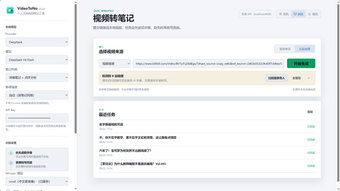
video-to-note: MCP server converting videos into AI-ready notes
video-to-note, developed by Like Attract, is an MCP server that connects video sources to Large Language Models for research and study purposes. It feeds video data into an AI environment so assistants can perform content queries and analysis instead of manual scrubbing. Key capabilities include MCP integration, multimodal processing, and task status tracking for long jobs. The app targets students, researchers, content creators, and power users who need faster extraction and synthesis from video media.
What tasks can you actually use it for?
The app turns recorded lectures, meeting recordings, and online tutorials into a format AI agents can query, supporting workflows that move from raw media to written outputs. Practical uses include generating study notes from classroom recordings, extracting action items from meeting videos, and producing summaries of YouTube tutorials. The server model fits into research and study pipelines where converting time-based media into searchable text reduces manual review time and enables natural-language interrogation.
How reliable are the generated transcripts and notes?
The project advertises automated transcription that converts audio tracks into accurate text transcripts and a structured note generator that transforms those transcripts into summaries and key takeaways. Multimodal processing links visual or audio cues to text, so the tool produces organized outputs rather than raw verbatim dumps. Quality depends on the upstream audio and video quality, but the stated design focuses on producing concise, structured notes from captured audio content.
What file sources and deployment requirements matter?
The server accepts video content from various sources, including YouTube, and runs as an MCP-compatible service. Deployment requires an MCP host such as Claude Desktop or Cursor and a local server environment using Node.js or Python. The app exposes task-monitoring endpoints, for example a get_task_status tool, to let clients query processing progress and retrieve results programmatically during long-running transcriptions.
Does it fit into developer and research workflows?
The developer positions the project as open source and extensible, which suits teams that modify processing pipelines or add custom parsers. Like Attract publishes the code for extension within the MCP ecosystem, so developers can adapt ingestion, note formatting, or agent integrations. The tool is aimed at technically capable users and research environments that already run MCP hosts and prefer embedding video-to-text services inside conversational agent contexts.
Practical choice for technically minded users embedded in MCP workflows
The app is a practical option for researchers and developers who already operate MCP hosts and need to convert video material into AI-consumable text and structured notes. Setup and hosting require developer familiarity with Node.js or Python, so users without that background face an integration overhead. For teams comfortable with open-source tooling, the app provides a focused way to bring video content into agent-driven workflows.